Enkerli
2015-12-08T00:43:04 annotation AVF_CqxU8sFu_DXLVL-x (3251)
age-old learning practice
Embedded reference to Talmudic traditions?
(AVIzRmq28sFu_DXLVa1a, AVIzNvHI8sFu_DXLVaz8)
115 total: 51 annotations, 64 replies
annotated by 16 users: slrichard, jasonadillon, Enkerli, sr931387, onewheeljoe, kfasimpaur, reedd, daniellynds, kschmidt39, dogtrax, wentale, dwhly, tellio, jeremydean, remiholden, nomadwarmachine
I appreciate the importance of annotation and social annotation as a part of the research process.
The role of social annotations as conversation offers a new purpose for some annotations. Sure, some people share books with annotations, but more people share in conversation when we go digital with the annotating.
any other kind of text
With “text”, here, in the broadest sense. Which some people outside the Humanities may not find so obvious. “A drawing is a text?” Well, yes, in this sense.
(AVI-egp38sFu_DXLVdC5, AVIzL6wU8sFu_DXLVay2)
age-old learning practice
Embedded reference to Talmudic traditions?
(AVIzRmq28sFu_DXLVa1a, AVIzNvHI8sFu_DXLVaz8)
slow readers down
Does the slow reading movement parallel the slow food one? In some ways, there might be a point against “consumption” in both cases. Or, at least, utilitarianism.
,
era of the Common Core
Acknowledging a related controversy to make the argument non-controversial.
that exercise can sometimes feel artificial.
Touché!
something we all do all the time
Sounds exaggerated, and there are people who probably go through life without annotating much. But point taken, annotation is a broad concept.
Annotation in academic settings
Providing context for the coalition (coming a bit over two weeks later).
,
yellow Post-its
I like sticky notes. So do my kids. But I know they fall off ...
(AVIzVYHU8sFu_DXLVa2P, AVIzR1kS8sFu_DXLVa1k)
public and collaborative space of social reading online
A very special space inasmuch as it has few offline equivalents. Sure, we might describe the class “lecture” in a similar way. But the type of collaboration involved is severely limited (and, in some cases, prohibited). This is one deep dimension of online annotation, which requires some “sink in” time. People are reading collaboratively, as a social activity, by sharing annotations asynchronously.
add multimedia marginalia
Especially useful in “today’s memetic marketplace”. The “image macro” isn’t the only format for memes, but it has become enmeshed with the concept.
, , ,
it can be a technique to slow readers down, deepen their engagement and aid in comprehension and analysis
This is so important, as a rationale for teachers to consider online annotation ...
(AVIzPyru8sFu_DXLVa0t, AVIzOaOZ8sFu_DXLVa0Q, AVIzNX9o8sFu_DXLVazq)
annotate
http://www.chambers.co.uk/search.php?query=annotate&title=21st
,
(AVIzROC-8sFu_DXLVa1K)
a comment on Facebook or YouTube.
So interesting to think of Twitter, etc. as annotation platforms. Twitter just announced they are going beyond 140 characters and adding the ability to screenshot text.
(AVIzNO0M8sFu_DXLVazl, AVIzNY8E8sFu_DXLVazt, AVIzM56d8sFu_DXLVazZ, AVIzMw218sFu_DXLVazT, AVIzMX_u8sFu_DXLVazF)
graffiti
I wonder how many people see graffiti as social annotations.
(AVI19ClD8sFu_DXLVbDN, AVIzO6X_8sFu_DXLVa0c)
in class and out
how can we think about annotation as a social/learning practice that moves across formal and informal settings? annotation is typically associated with academic (i.e. in-school) discourse, such as research or archival reference. how does the practice of annotation change when it is tied to out-of-school people and places, and also connected to more formal/academic practices?
making notes in the margins of books
I hate doing this - the notes get lost. I much prefer Hypothes.is, which keeps all my notes in one place
Skills and Strategies | Annotating to Engage, Analyze, Connect and Create
Please use this tag below for your annotations--nextprez
If you tweet out, please use #nextprez.
By Jeremy Dean and Katherine Schulten
Jeremy Dean, bio at Hypothes.is. Katherine Schulten, bio at NYTimes
, ,
What is social media but spaces where people annotate texts and images,
I think that quite often social media is curation, not annotation
(AVI1-zWR8sFu_DXLVbD7, AVIzMzXF8sFu_DXLVazX, AVIzMg6V8sFu_DXLVazL, AVIyLvr08sFu_DXLVald)
We are living increasingly in a culture of response.
This is also from Henry Jenkins' ideas on Participatory culture and produsage right?
,
(AVI1qlyo8sFu_DXLVbCl, AVIzOI398sFu_DXLVa0J)
In this post we hope to both expand their definition of what annotation can be and inspire them to experiment with new ways of doing it
purpose of article--a call to action.
, ,
(AVIzSdFb8sFu_DXLVa1w)
slow readers down,
slow reading, slow eating, slow .... a new zeitgeist?
,
(AVI-e0an8sFu_DXLVdC9)
Several years ago, the website Genius (formerly Rap Genius) was established to annotate music lyrics hosted on its platform. It’s proven to be something young people happily do on their own, discussing the word choices and poetic devices used by their favorite musicians in the same way their teachers ask them to discuss great works of literature in class.
These participatory online platforms are used by a small number of youth, who engage with the web to pursue their interests. Most youth, studies show, use the web for friendship-driven practices and aren't familiar with learning platforms. That's an equity issue, especially if youth learn about the potential of the web for self-directed learning at home and in "third spaces."
(AVI2Aakc8sFu_DXLVbEK, AVIzPbR_8sFu_DXLVa0k, AVIzNAra8sFu_DXLVaze, AVIzMvsn8sFu_DXLVazR)
maps
I love the annotation of maps, and the various tools that bring life to mapping ideas ... including the multimedia aspects of annotation .... showing us dark corners of the map and forgotten corners of the world ...
(AVIzUNZE8sFu_DXLVa2A, AVIzOSK38sFu_DXLVa0N)
close reading 2.0
Catch-phrase of the Common Core era ... but probably a selling point for many teachers to consider digital annotation ....
(AVIzPm9H8sFu_DXLVa0s)
variety of tools
I like Hypothesis and the others here, but none feel like a natural fit for me in terms of conversation. I like this threaded element, but it still feels as if some of the bars for entry and participation leaves some folks out (unintentionally). I think we are making strides, though.
(AVIzSFXK8sFu_DXLVa1p, AVIzQSOs8sFu_DXLVa0z, AVIzOl_I8sFu_DXLVa0W)
to not just passively read but to fully enter a text, to collaborate with it, to mingle with an author on some kind of primary textual plane.
I'm wondering how this mingling with the author changes when it is public annotation. Is it a less intimate reading?
Michael Chabon also added an annotation to the final couplet of the track.
Celebrity annotation--is that added value?
,
(AVIzN1bw8sFu_DXLVa0A, AVIzNnbl8sFu_DXLVazz, AVIzNXMX8sFu_DXLVazo, AVIzNJca8sFu_DXLVazj)
The series Anatomy of a Scene invites film directors to comment on their own work.
I use Vialogues to do the same kind of video annotation.
the teacher’s role here is as co-learner in the reading process, observing and coaching student thinking on the side.
This is crucial ... and Terry is talking right now about videocasting annotation activity to show the work you are doing (but we do lose real authenticity? Are we annotation for the camera?)
Wrestle With
https://media.giphy.com/media/7CaHmP2XVqrWE/giphy.gif
audio recordings on 12 months of reading
Is this for him? Or for the world? You wonder about intention with annotation, and the value of it. Sometimes, I notice annotations get lost in the mix, and I wonder the real value of doing this: is it for me, to better understand? Or to gather with you, to share understanding? Both?
(AVIzUQ-E8sFu_DXLVa2C)
annotations must be public
It looks like the teacher can set up "groups." How do you join different groups? Can a teacher set up a group for each class?
Sarah Gross, a high school teacher and contributor to our blog, did recently using Hypothesis with her senior class as they read the Opinion piece “What Really Keeps Women Out of Tech.”
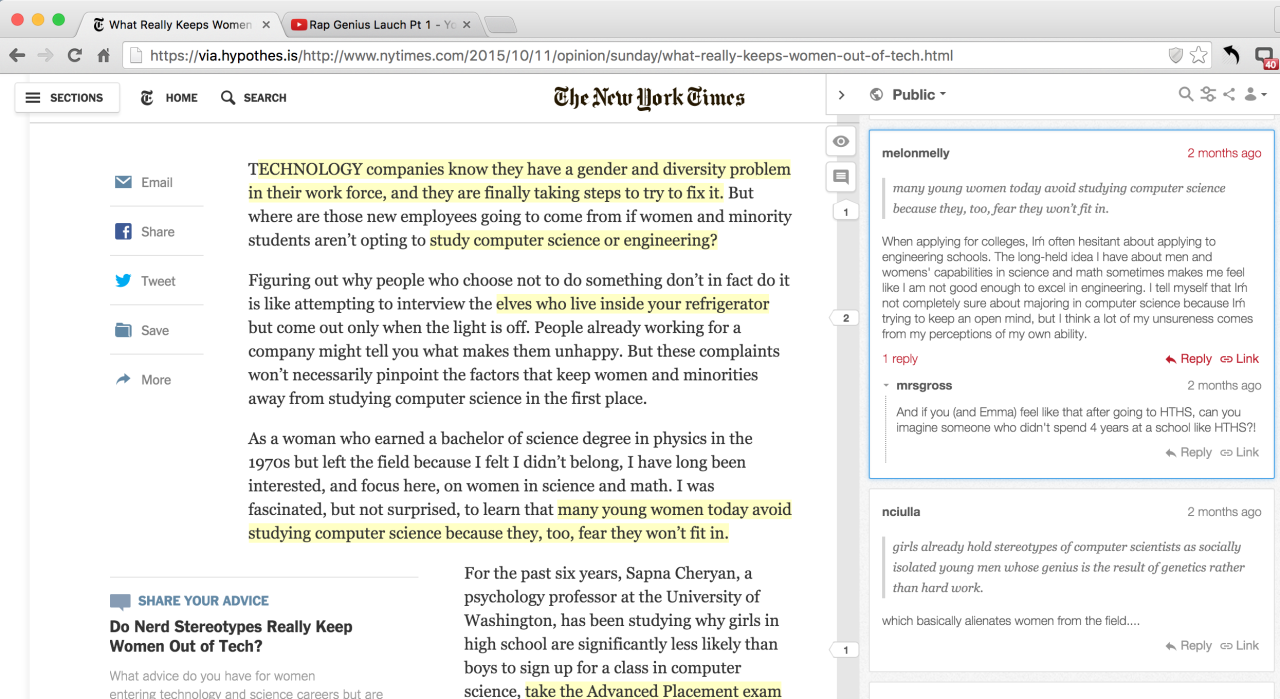 When this teacher asks her class to annotate online about an equity issue, the students are working in an environment where they might encounter public feedback and also influence public opinion.
Eight Ways to Experiment With Annotation Using The New York Times
,
Connect parts of the text to other parts with arrows.
Is it possible to do this with Hypothes.is?
(AVJKX-Ru8sFu_DXLVelP, AVI2CP9z8sFu_DXLVbES, AVIzQ9by8sFu_DXLVa1G, AVIyMDtc8sFu_DXLValh)
a way of working many find much more engaging than individual analog annotation
It is interesting to start with comments and then go to text, different from reading the text and when there is an annotation decide to read. I hate to say, but could be used kind of like cliffnotes?
(AVIzUeW_8sFu_DXLVa2E, AVIzRLpQ8sFu_DXLVa1I)
often requires background knowledge students don’t have
I've so often found background knowledge to be the major stumbling block for my middle and high school students. I'm intrigued by the potential for a group of students to use collaborative annotation to "crowd source" their background knowledge.
Make connections
I'm connecting this with Sarah's comment (hopefully) https://hypothes.is/a/AVIyDIYO8sFu_DXLVai1 mmmm, nope, that didn't work. What does the "Link" option do then?
, ,
a reference to Lincoln annotated with a photo of the 16th president
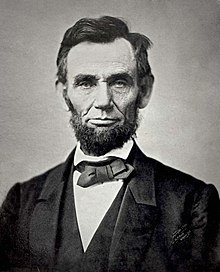
Ask students to fact-check a claim made in an article.
I love this idea ... particularly in this political season ... prove something right/prove something wrong ...
(AVIzSnfH8sFu_DXLVa1y, AVIzRw1P8sFu_DXLVa1h)
annotating explicitly to make connections between what they’re reading and the rest of the world can help them see why particular texts matter and are still relevant today
I think this is a great point. Readers/annotators can add modern relevance to classic texts.
,
archival news reports
https://www.youtube.com/watch?v=qv2r6STbXhE
digital version of a traditional annotated bibliography from here, page-level annotations
I've found this to be a powerful practice with my students. As I see their bibliographies develop in real time, I see all sorts of opportunities to probe, prod, assist, or otherwise intervene to support the research process.
teachers can monitor student work like a portfolio
Intrigued by how this would work ... the management of it ...
Like scrolling through a friend’s Facebook page or Twitter feed, seeing someone else navigate the world through annotation can be compelling and edifying.

In this way, we can attend to annotations as texts themselves.
This part I find harder to get my head around. How this make sense and is useful.